Igbo Riddles


Igbo Riddles Summary
Igbo Riddles is a ad-supported Android app in the Books And Reference category, developed by Merizek Works. First released 5 years ago(Jul 2020), the app has accumulated 4.1K+ total installs
Recent activity: 12 installs this week (62 over 4 weeks) showing below average growth View trends →
Store info: Last updated on Google Play on Jul 13, 2020 .
0★
Ratings:
Screenshots


App Description
Gwam-Gwam is known as Igbo Riddles. African people call it 'Tell-Tell'
It’s fun to ask riddle question… It’s fun to answer… It’s more than a game.
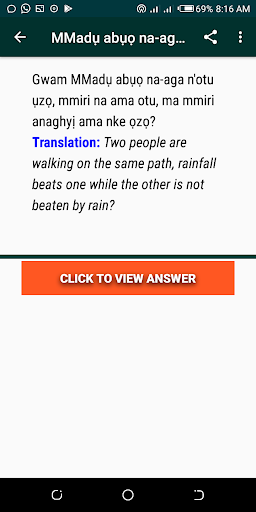
Gwam-Gwam (Igbo Riddles) is a genre of oral literature that can be played by your children, friends and spouses of all status. It is a speech that requires indigenous thinking and qualitative approach before answering. This is one of the ways Igbo people transmit their culture from a generation to the next.
I remember when I was a child, riddles is what we play with to catch fun. It is a play of who will remember the questions, folklore story lines and answer it correctly. It broadens every child’s knowledge and also addresses vast areas of lives with great discipline. It is generally acceptable in Igbo land that it teaches moral.
Now, I can't remember the last time I heard someone say, "Gwam Gwam Gwam," again. It is gradually fading away and now becoming a thing of the past. That is why we want to reawaken it again so as to promote our rich cultural heritage that speaks who we are. “Because our people say that a river that forgets its source will run dry”.
Every race both black and white have their own riddles that promote their cultures. It stimulate careful consideration or attention because it deals with the subject of human nature. Gwam-Gwam-Gwam also know as Tell-Tell-Tell (Igbo riddles) serves as a toy, for children to play with. One asks, and the other answers. This is opposed to knowing if a person will be exhausted by failing or forgetting something else to ask. This makes the human brain sharp, more like a razor. The interviewee thinks about the answer to the question asked, and thinks about the one to ask.