Kids Math Garden

Kids Math Garden Summary
Kids Math Garden is a mobile Android app in Education by nummolt. Released in Feb 2017 (9 years ago). It has about 794+ installs Based on AppGoblin estimates, it reaches roughly 14 monthly active users . Store metadata: updated Feb 1, 2017.
Recent activity: 2.00 installs this week (7.00 over 4 weeks) showing steady growth View trends →
Store info: Last updated on Google Play on Feb 1, 2017 .
4.16★
Ratings: 0
Screenshots


App Description
Cultivate virtual dandelions with the natural numbers & prime seeds agriculture
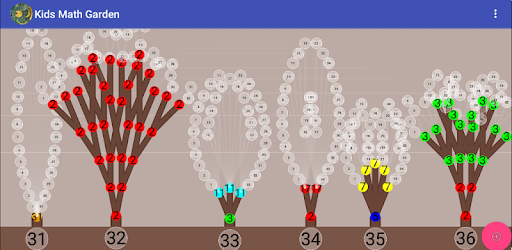
Kids Math Garden: Play basic arithmetic with plant shaped numbers.
In this app, the natural numbers are represented as vegetables (plants):
(Plants similar to Dandelions, from French: 'dent-de-lion')
Seeds fall from the sky
They should be planted. And then grow the plant corresponding to the seed (and the number chosen).
When the time comes to harvest dandelions, the plant is plucked from the ground.
Then the dandelions that it has generated are released.
And the seeds return to sky.
The particular operation is similar to that of the numbers:
If two unseeded seeds overlap, they add up.
If two seeds are planted, the plants multiply.
The plants are structured in branches, forking in function of the prime numbers that compose the factorization of the number.
Plants multiplied underground, often have a structure different from plants planted in a single blow.
(Multiplied plants do not have the usual order of a well-made factorization)
Each plant generates as many little dandelions as the number that indicates its seed, Having any of the structures that may have.
The program has 30 furrows one behind the other to be able to plant.
From version 1.1.0 r5: By night: seeds coming from sky become negative.
From 1.2.1 r8 use fractions
Fraction seeds, based on Touch Fractions Q (same developer)
Proper Fractions, improper, and Mixed Fractions.
HERE: "The order of the factors does not alter the product, but the shape of the resulting plant".
[App Icon: Nebra Sky Disk: The disk is attributed to a site near Nebra, Saxony-Anhalt, in Germany, and associatively dated to c. 1600 BC. It has been associated with the Bronze Age Unetice culture.]