新年祝福-2026 新歲至,喜迎春節!快來製作新春賀卡吧


新年祝福-2026 新歲至,喜迎春節!快來製作新春賀卡吧 Summary
新年祝福-2026 新歲至,喜迎春節!快來製作新春賀卡吧 is a ad-supported, with in-app purchases Android app in Tools by ShenYang Chinese. Released in Dec 2020 (5 years ago). It has about 27.1K+ installs Based on AppGoblin estimates, it reaches roughly 1.4K monthly active users and generates around $<10K monthly revenue (62% IAP / 38% ads). Store metadata: updated Feb 8, 2026.
Recent activity: 7.00 installs this week (1.7K over 4 weeks) showing exceptional growth View trends →
Store info: Last updated on Google Play on Feb 8, 2026 .
0★
Ratings: 0
Screenshots

App Description
The app collects tens of thousands of holiday greetings, making it easier to send blessings during the Lunar New Year! You can also create exclusive greeting cards, covering New Year's Day, New Year's Eve, Spring Festival, New Year and Lantern Festival blessings, as well as daily greetings and selected couplets to add more warmth and surprise to the festival!
I. App Introduction
🔥The hottest New Year's greeting app for the Year of the Horse 2026! Includes the latest exclusive Lunar New Year greetings for the Year of the Horse 2026, a million-strong blessing SMS library covering all scenarios, send to relatives and friends with one click, and even create exquisite Year of the Horse themed greeting cards, making New Year's blessings more ceremonial!
Wishing everyone a prosperous Year of the Horse 2026, full of vigor and spirit, with red envelopes galore, abundant wealth, peace and prosperity, and all things going smoothly!
The Spring Festival, also known as the Lunar New Year, is the first day of the year and the traditional festival. It is commonly called New Year, New Year's Day, New Year's Eve, etc., and colloquially referred to as "passing the year," "celebrating the year," "celebrating the New Year," or "celebrating the big New Year." The Spring Festival has a long history, evolving from ancient New Year's prayer and sacrificial rites. All things originate from Heaven, and humans originate from their ancestors; praying for a good harvest and offering sacrifices, respecting Heaven and ancestors, is a way of repaying one's roots and returning to the origin. The origin of the Spring Festival contains profound cultural connotations and carries a rich historical and cultural heritage in its inheritance and development. The Spring Festival in 2026 falls on February 17th. As we bid farewell to the old year and welcome the new, let us send our warmest wishes and sincere affection.
Thank you for your support! Wishing you a happy Spring Festival 2026, a happy family, all the best, abundant blessings, and instant success!
II. Application Functions
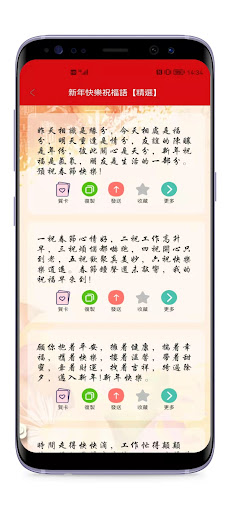
★ Year of the Horse Exclusive Categories: Carefully selected categories for Year of the Horse blessings, Spring Festival greetings, New Year's greetings to relatives and friends, and workplace blessings. Each item is high-quality content carefully chosen.
★ Precise Keyword Search: Supports keywords for festivals such as the Year of the Horse, Spring Festival, New Year's Day, Lunar New Year's Eve, and Lantern Festival, quickly locating the desired blessings and doubling search efficiency.
★ One-Click Collection and Backup: Easily collect classic blessings worth keeping. Cloud synchronization ensures no loss, making it easier to find next time.
★ One-Click Copy and Send: Find your favorite greetings and copy them with one click to share directly with loved ones, family, friends, and colleagues, saving time and effort.
★ Cross-Platform Image and Text Sharing: One-click sharing to QQ, WeChat, Weibo, Facebook, Telegram, Instagram, and other domestic and international social media platforms, covering all social scenarios.
★ Chinese-English Bilingual Translation: Real-time online translation between Chinese and English (Chinese to English, English to Chinese), ensuring seamless communication for cross-border blessings and international friends.
★ Quick Simplified/Traditional Chinese Conversion: One-click switching between Simplified and Traditional Chinese characters, adapting to the usage habits of Hong Kong, Macau, Taiwan, and overseas Chinese communities. ★ Personalized Font Settings: Offers various font styles (calligraphy, cartoon, regular script, etc.) to make your New Year's greetings more unique.
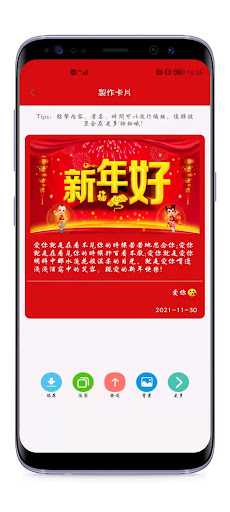
★ Horse Year Greeting Card Creation: A vast library of Horse Year-themed templates + warm greetings, customize your own exclusive New Year's card for a truly special experience.
------------Greeting Card Support-------------
1. Freely edit and modify your greetings to express your personal sentiments.
2. Customize the font color of your greetings for a more aesthetically pleasing look.
3. Sign your own name for greater recognition.
4. Supports hiding your signature to meet your privacy needs.
5. Change the Horse Year theme background (zodiac horse, New Year elements, traditional patterns, etc.).
6. Send greeting cards directly to friends and family within the app with one click.
7. Save greeting cards to your phone's local photo album for permanent preservation.
8. Share greeting cards through multiple channels to spread New Year's joy.
III. Example Greeting Messages
1. The Year of the Horse 2026 is here, may good fortune shine upon you! I'm sending you a golden ingot, not filled with gold or silver, but with every word expressing my true feelings. 1. May good fortune surround you, wealth adore you, health and peace cling to you, and happiness and auspiciousness accompany you. Wishing you a happy and successful Year of the Horse!
2. The Year of the Snake bids farewell, the Year of the Horse welcomes the New Year! Firecrackers crackle, red makeup is adorned, spring flowers quietly smile, and blessings echo endlessly. May you, at the beginning of the New Year 2026, tightly grasp happiness, embrace joy, rely on good fortune, and cast away all sorrows. Happy Year of the Horse!
3. Wishing you a Happy Chinese New Year 2026: First, may your whole family be well; second, may difficulties be few; third, may worries disappear; fourth, may you never grow old; fifth, may your children be filial; sixth, may happiness surround you; seventh, may sorrows be cast aside; eighth, may your income be high; ninth, may peace protect you; tenth, may you enjoy carefree joy. May the Year of the Horse bring you abundant blessings!
4. Life is a journey of tears and sweat; on the road to success, there is bitterness and sweetness. Thank you for your hard work throughout the year. We look forward to more companionship and assistance in the Year of the Horse 2026. Wishing you a Happy New Year, smooth work, a happy life, and the spirit of a dragon and horse!
5. A message, offered with both hands, carrying three parts longing, four parts blessings, five parts concern, six parts affection, seven parts luck, eight parts happiness, and nine parts peace, delivered to your side. Wishing you a Merry Christmas, a prosperous New Year, perfection in everything, and a lucky Year of the Horse!
6. Sunrise and sunset mark a day, flowers bloom and wither mark a year. New Year's Day 2026 has arrived, followed by Laba Festival. I send you my warmest and most beautiful blessings: May you be endlessly happy every day, blessed with happiness and peace every year, and may the Year of the Horse bring you even more fortune and joy!
7. It's New Year's Eve 2026 again. I send a special blessing, only to those I care about most, those who are healthy, and those who are happy! I don't send these to just anyone~ Hehe, wishing you a happy New Year's Eve and a prosperous Year of the Horse!
8. A touch of sincerity is worth more than a thousand taels of gold, a touch of warmth can dispel the frost of ten thousand miles, a greeting brings warmth and sweetness, and a text message conveys my sincere blessings for the Year of the Horse 2026. Wishing you a Happy New Year and good health!
9. During the Spring Festival of 2026, I send you the sound of firecrackers; during the Lantern Festival, I send you sweet dumplings; during the Great Heat, I send you cooling relief from the heat; on Guanyin Day, I send you great compassion. Today is Guanyin Day, remember to be kind to others, and may the Year of the Horse bring you abundant blessings!
10. During the Spring Festival and Lantern Festival of 2026, text message blessings will surely abound. The evening breeze and the moon are filled with joyous celebration, firecrackers boom and fireworks light up the sky. Though separated by vast distances, true friends are always close at hand. Sweet New Year cakes symbolize rising higher each year, round dumplings celebrate family reunions, and the Year of the Horse brings boundless joy and togetherness!
IV. Introduction to Included Festivals
1. New Year's Day, referring to the first day of the new year in the Gregorian calendar, i.e., January 1st of the Gregorian calendar, also known as the solar new year, is a statutory holiday in most countries around the world. In many countries, the New Year celebrations extend from Christmas to New Year's Day, with the number of holidays varying depending on local customs. New Year's greetings for 2026 have been updated to meet the needs of year-end greetings.
2. Spring Festival, also known as Lunar New Year, is the most important traditional festival for the Chinese nation. The Spring Festival has a long history, originating from the sacrificial activities to gods and ancestors at the end of the year during the Yin and Shang dynasties. According to the lunar calendar, the first day of the first lunar month was formerly called Yuanri, Yuanchen, Yuanzheng, Yuanshuo, Yuandan, etc., commonly known as the first day of the new year; after the adoption of the Gregorian calendar during the Republic of China period, January 1st of the Gregorian calendar was called New Year's Day, and the first day of the first lunar month was officially named the Spring Festival. The Spring Festival in 2026 falls on February 17th of the Gregorian calendar, corresponding to the Year of the Horse (丙午), and is an important time for bidding farewell to the old year and welcoming the new, and for family reunions.
Influenced by Chinese culture, some countries and ethnic groups within the Sinosphere also celebrate the Spring Festival. The app simultaneously includes cross-border greetings to meet diverse needs.
Leap Spring Festival: Also known as a leap January, the leap January occurs only six times in the 1155 years from 1645 AD (when the lunar calendar adopted the leap month system) to 2800 AD. These leap Januarys are extremely rare, occurring in 1651, 2262, 2357, 2520, 2539, and 2634.
How to Celebrate a Leap Spring Festival: In principle, if a year has a leap January, the Spring Festival is celebrated in the first January of the lunar calendar, not during the leap January itself. However, in a few regions, the leap January Spring Festival is celebrated after the first January Spring Festival, as it is still considered a January, and the first day of the leap January is regarded as the Spring Festival. All of these practices conform to traditional customs.
Earliest and Latest Spring Festivals: The Spring Festival falls between January 21st and February 21st of the Gregorian calendar. The Beginning of Spring (Lichun) usually falls on February 4th or 5th. The earliest Spring Festival (e.g., January 21, 1966) and the latest Spring Festival (e.g., February 20, 1985) differ by a full month. According to calendar calculations, if the lunar calendar is not artificially adjusted, February 21, 2319 will mark the latest Spring Festival in history.
3. New Year's Eve, the last night of the twelfth lunar month, usually falls on the 29th or 30th day of the twelfth lunar month, hence also called the 30th of the year. It is one of the most important traditional festivals of the Han Chinese. The last day of the lunar year is called "Sui Chu" (岁除), and the night is called "New Year's Eve" (除夕). New Year's Eve has ancient customs such as staying up late, eating New Year's Eve dinner, eating dumplings, pasting door gods, Spring Festival couplets, and New Year pictures. In 2026, the Year of the Horse, New Year's Eve will fall on February 16th in the Gregorian calendar. The app includes exclusive New Year's Eve blessings, suitable for family reunion scenarios.
The origin and history of New Year's Eve: The custom of staying up late on New Year's Eve is related to the ancient custom of gathering around a stove at the end of the year. Fire held a significant place in primitive society; only the most prestigious women could manage clan cooking and other activities. The primitive custom of gathering around the hearth at the end of the year gradually evolved into Lunar New Year's Eve. Records from the Zhou Dynasty show the Zhou emperor and his court officials exchanging New Year's greetings. During the Western Han Dynasty, it became a royal custom for the emperor and his officials to exchange New Year's greetings. During the reign of Emperor Wu of Han, the *Taiyin Calendar* was promulgated, officially establishing the New Year's Day celebrations, and Lunar New Year's Eve became an important festival. During the Tang and Song Dynasties, Lunar New Year's Eve was widely valued as a New Year's festival.
4. The Lantern Festival, the fifteenth day of the first lunar month, also known as the Shangyuan Festival, the Little New Year, Yuanxi, or the Lantern Festival, is the first important festival after the Spring Festival. It is a traditional festival in China, the Chinese cultural sphere, and among overseas Chinese communities. The first month of the lunar calendar is called "Zhengyue," and the ancients called night "Xiao," hence the fifteenth day of the first lunar month is called the Lantern Festival. In 2026, the Year of the Horse, the Lantern Festival falls on March 2nd in the Gregorian calendar. The app will simultaneously update with exclusive Lantern Festival blessings and greeting card templates.
Eating Yuanxiao (Sweet Rice Balls): Eating Yuanxiao on the fifteenth day of the first lunar month is a long-standing tradition in China. During the Song Dynasty, a novel food for the Lantern Festival became popular, initially called "Fu Yuanzi," later "Yuanxiao," which merchants affectionately called "Yuanbao" (meaning "gold ingot"). Yuanxiao (sweet rice balls) are filled with various fillings such as white sugar, rose petals, sesame seeds, red bean paste, osmanthus, walnuts, nuts, and jujube paste, wrapped in glutinous rice flour into a round shape. They can be made with either vegetarian or non-vegetarian fillings, and can be boiled, fried, or steamed, symbolizing reunion and happiness.
Viewing Lanterns: During the Yongping era of Emperor Ming of Han (58-75 AD), Emperor Ming promoted Buddhism. At the same time, Cai Yin returned from India with Buddhist scriptures, reporting that in Magadha, India, monks gathered to venerate the Buddha's relics on the fifteenth day of the first lunar month, making it an auspicious day for Buddhist worship. To promote Buddhism, Emperor Ming ordered that lanterns be lit in the palace and temples on the night of the fifteenth of the first lunar month to "represent the Buddha." After that, the custom of lighting lanterns during the Lantern Festival spread from the imperial court to the common people. Every year on the fifteenth day of the first lunar month, both noble families and commoners would hang lanterns, and the cities and towns would be brightly lit all night long.