Sound Analyzer Basic


Sound Analyzer Basic Summary
Sound Analyzer Basic is a ad-supported Android app in Music And Audio by nobapp. Released in Dec 2015 (10 years ago). It has about 456K+ installs and 889 ratings with a 4.29★ (good) average. Based on AppGoblin estimates, it reaches roughly 6.8K monthly active users and generates around $<10K monthly revenue (0% IAP / 100% ads). Store metadata: updated Sep 11, 2025.
Recent activity: 657 installs this week (4.5K over 4 weeks) showing steady growth View trends →
Store info: Last updated on Google Play on Sep 11, 2025 .
4.29★
Ratings: 889
Screenshots



App Description
A High-Precision Audio Spectrum Analysis App
Sound Analyzer Basic is an application for analyzing audio signals using only a mobile device.
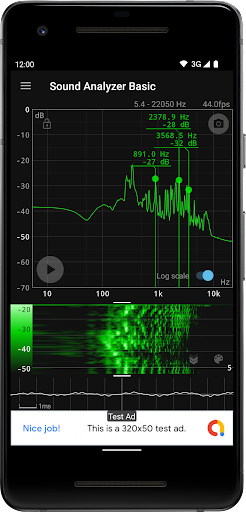
Its main function is to display frequency (Hz) and amplitude (dB) spectra in real time, but it can also be used to display changes in spectra over time (waterfall view) and to display waveforms (waveform view) at the same time.
The frequency measurement accuracy of Sound Analyzer Basic is very high, and in a relatively low-noise environment, the measurement error is generally within 0.1 Hz. (when measured with default settings)
Main Functions
- Peak frequency display function (displays the frequency [Hz] and amplitude [dB] of prominent spectral components in real time)
- Change of display range by touch operation
- Switchable frequency axis scale between logarithmic and linear scale
- Waterfall view (displays spectral changes over time)
- Waveform view (displays sound waveforms)
- Screenshot function (with timer)
About High Frequency Range Spectrum
The app allows the highest frequency setting to be raised to 96 kHz, but settings above 22.05 kHz are for devices with high-quality audio input and are not intended for general-purpose devices.
In most devices on the market today, data in the high frequency range above about 22 kHz is filtered out. Since it is not possible to acquire data in the removed range even with a higher setting value, it is normal for the spectrum in this range to contain only weak noise of less than -60 dB.
However, depending on the model, larger noise due to filter processing may appear at certain frequencies such as 48 kHz and 96 kHz.