Astronomy Amazing Space Facts
Astronomy Amazing Space Facts Summary
Astronomy Amazing Space Facts is a mobile iOS app in Education by Yaroslav Palamar. Released in Mar 2018 (8 years ago). Store metadata: updated Mar 7, 2018.
Store info: Last updated on App Store on Mar 7, 2018 .
0★
Ratings:
Screenshots

App Description
Learning by Listening!
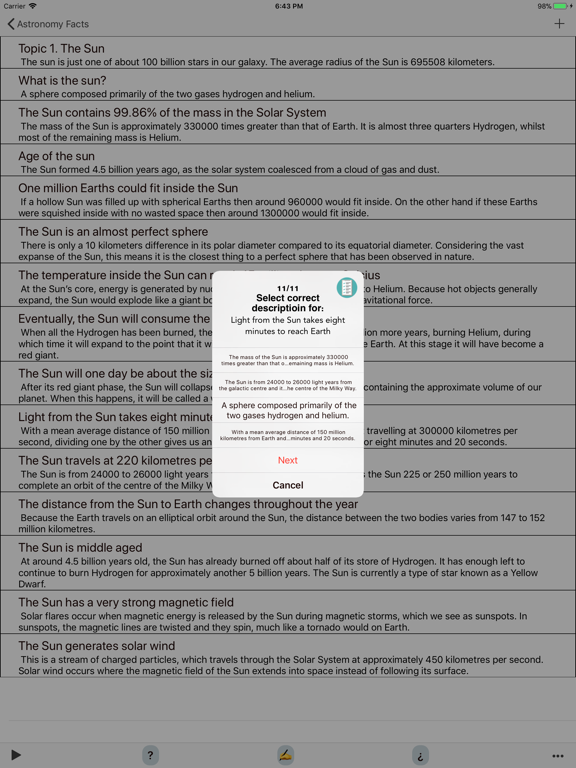
With "Astronomy, Amazing Space Facts" app you can read and write, listen, pass tests and learn faster, in result you will get fun and obtain more knowledge!
Application "Astronomy, Amazing Space Facts" include next themes and works offline:
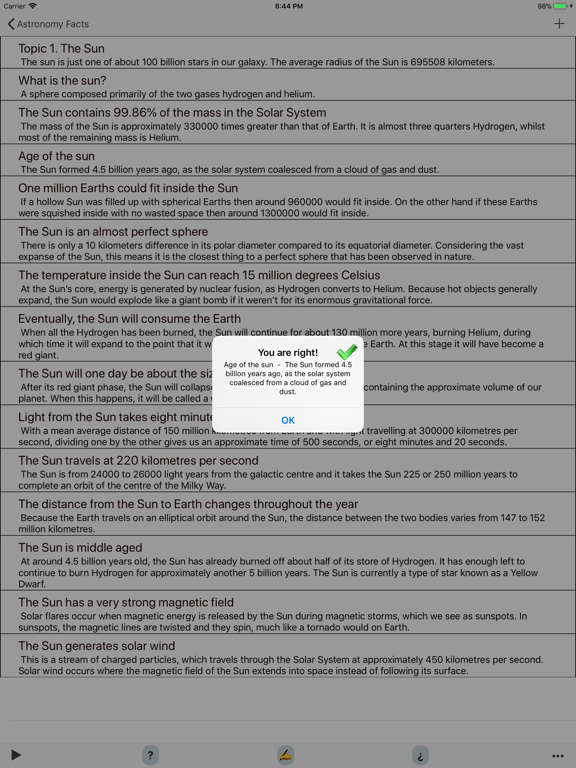
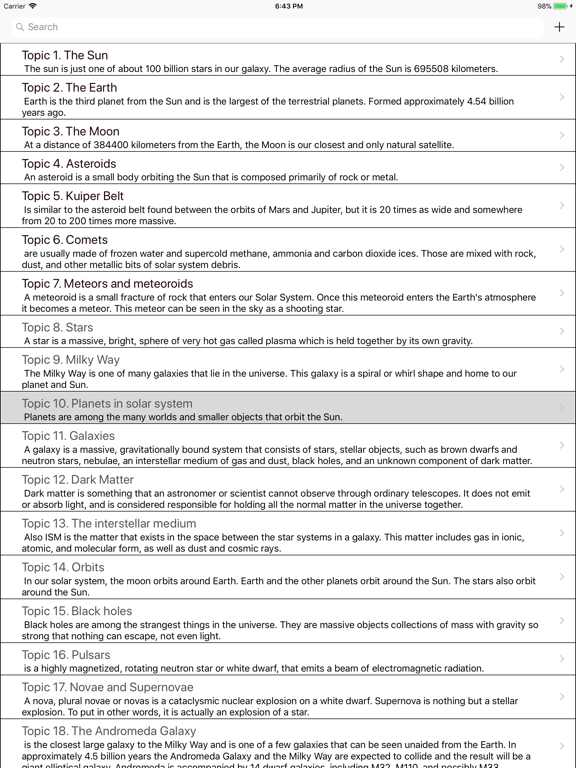
Topic 1. The Sun - The sun is just one of about 100 billion stars in our galaxy. The average radius of the Sun is 695508 kilometers.
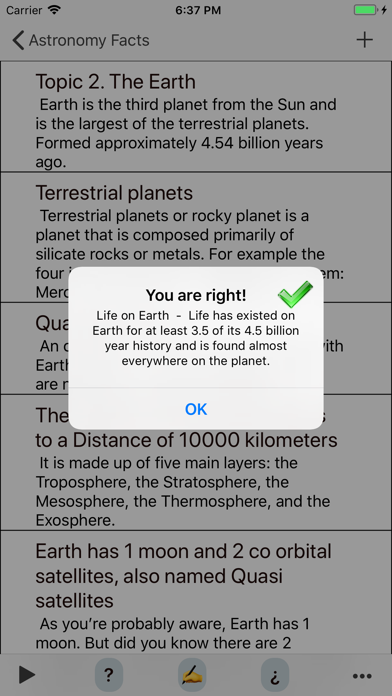
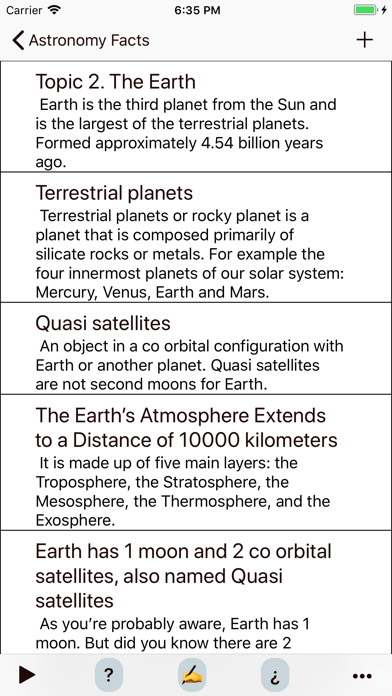
Topic 2. The Earth - Earth is the third planet from the Sun and is the largest of the terrestrial planets. Formed approximately 4.54 billion years ago.
Topic 3. The Moon - At a distance of 384400 kilometers from the Earth, the Moon is our closest and only natural satellite.
Topic 4. Asteroids - An asteroid is a small body orbiting the Sun that is composed primarily of rock or metal.
Topic 5. Kuiper Belt - Is similar to the asteroid belt found between the orbits of Mars and Jupiter, but it is 20 times as wide and somewhere from 20 to 200 times more massive.
Topic 6. Comets - are usually made of frozen water and supercold methane, ammonia and carbon dioxide ices.
Topic 7. Meteors and meteoroids - A meteoroid is a small fracture of rock that enters our Solar System.
When you try to open either topics from 8 to 14 or topics from 15 to 20 you will be asked to purchase them.
Locked topics list (part 1):
Topic 8. Stars - A star is a massive, bright, sphere of very hot gas called plasma which is held together by its own gravity.
Topic 9. Milky Way - The Milky Way is one of many galaxies that lie in the universe. This galaxy is a spiral or whirl shape and home to our planet and Sun.
Topic 10. Planets in solar system - Planets are among the many worlds and smaller objects that orbit the Sun.
Topic 11. Galaxies - A galaxy is a massive, gravitationally bound system that consists of stars, stellar objects, such as brown dwarfs and neutron stars, nebulae, an interstellar medium of gas and dust, black holes, and an unknown component of dark matter.
Topic 12. Dark Matter - Dark matter is something that an astronomer or scientist cannot observe through ordinary telescopes. It does not emit or absorb light, and is considered responsible for holding all the normal matter in the universe together.
Topic 13. The interstellar medium - Also ISM is the matter that exists in the space between the star systems in a galaxy. This matter includes gas in ionic, atomic, and molecular form, as wel