Yin and Yang

Yin and Yang Summary
Yin and Yang is a free, with in-app purchases iOS app in Board by Uwe Meier. Released in Dec 2010 (15 years ago). It has 20 ratings with a 4.60★ (excellent) average. Based on AppGoblin estimates, it reaches roughly 87 monthly active users and generates around $<10K monthly revenue (100% IAP / 0% ads). Store last updated Nov 10, 2017
Yin and Yang SDKs Summary
App not yet scanned for SDKs.
4.6★
Ratings: 20
Screenshots
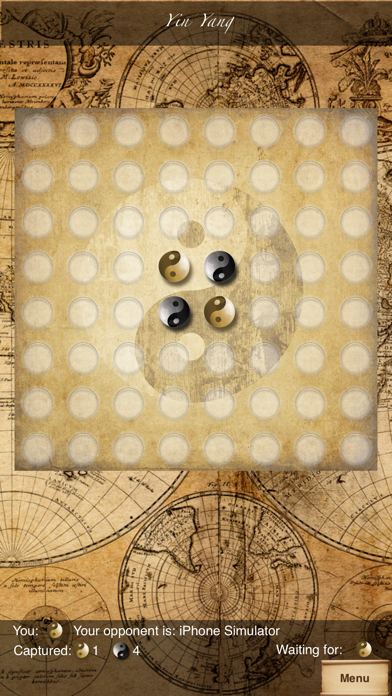

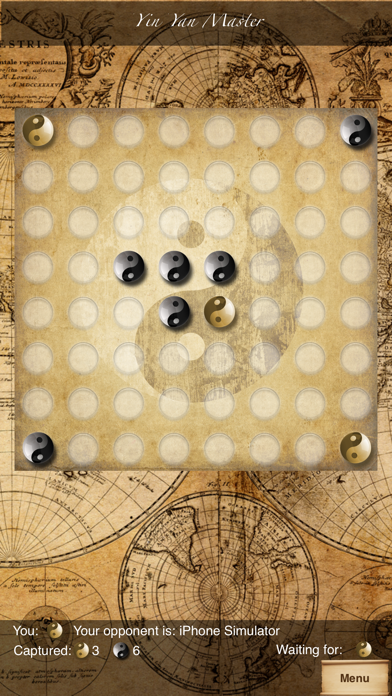
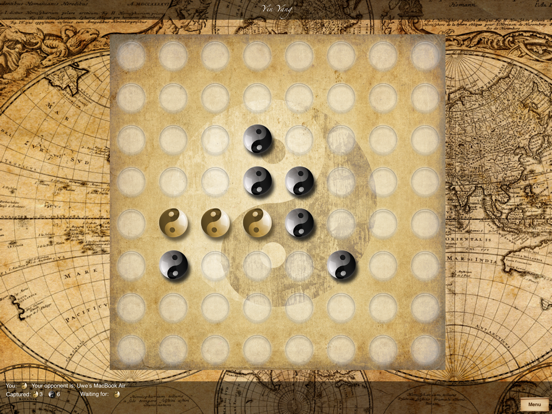
App Description
In Yin and Yang you have to master the dualities Yin and Yang. You start out with quiescence of the elements, but you have to change faith to your advantage. You need a good strategy to break the quiescence
to your advantage. But be careful, your opponent will try the same thing and you might end up loosing most of you Taijitu pieces that symbolize your faith.
- Yin and Yang takes place between two players. The first player symbolizes the Yin, the second player symbolizes the Yang
-It is played on an 8x8 board of 64 squares. There are 64 Taijitu pieces, colored black for player representing Yin and gold for the player representing Yang.
- In the basic game, the board is set up initially with two Taijitu pieces for each player. The advanced games (Challenge and Master) have more pieces on the initial board)
- Yang (black Taijitu) makes the first moved. Players are then taking alternate turns.
- When making your move, you can change faith by forcing pieces on the board to change from Yin to Yang or Yang to Yin.
- Goal of the game is, once all the pieces are placed to have more pieces than your opponent on the board.
- At each turn a player must place a Taijitu piece with their color face up on one of the empty squares of the board, adjacent to an opponent's Taijitu piece, such that one or
more straight lines (horizontal, vertical or diagonal) are formed from the newly placed disc, through one or more of the opponent's discs and up to other Taijitu pieces of their own color already
on the board. All the intervening Taijitu pieces of the opponent's color are flipped to the faith (Yin/Yang) of the newly laid Taijitu piece.
-Taijitu pieces may be flipped from one faith to the other but once played are not moved from one square to another or removed from the board.
- Players may not pass unless there is no valid move available to them in which case they must pass.
-Play continues until neither player is able to move, usually when all 64 squares have been played.
- The player with most piece of their faith wins
History
In Chinese philosophy, the concept of yin yang, normally
referred to in the West as yin and yang) is used to describe how polar or seemingly contrary forces are interconnected and interdependent in the natural world, and how they give rise to each other
in turn. The concept lies at the origins of many branches of classi