Nigerian Currency Gallery
Nigerian Currency Gallery Summary
Nigerian Currency Gallery is a mobile iOS app in Books And Reference by Abdulkarim Nasir. Released in Nov 2022 (3 years ago). Store metadata: updated Jul 8, 2024.
Store info: Last updated on App Store on Jul 8, 2024 .
0★
Ratings: 0
Screenshots


App Description
During the pre-colonial era, different cultures used a variety of items as means of exchange. These included cowries, manilas, beads, bottles and salt amongst others.
The first major currency issue in Nigeria was undertaken sequel to the colonial ordinance of 1880 which introduced the Shillings and Pence as the legal tender currency in British West Africa. The units of coins managed by the Bank of England were one shilling, one penny, 1/2 penny and 1/10 penny and were distributed by a private bank, the Bank for British West Africa till 1912.
From 1912 to 1959, the West African Currency Board (WACB) issued the first set of banknotes and coins in Nigeria, Ghana, Sierra Leone and the Gambia. The highest banknote denomination was one pound, while the one shilling coin was the highest coin denomination.
On 1st July, 1959 the Central Bank of Nigeria (CBN) issued Nigerian currency banknotes, while the WACB-issued banknotes and coins were withdrawn. It was not until 1st July, 1962 that the currency was changed to reflect the country’s republican status. The banknotes which bore the inscription, ’FEDERATION OF NIGERIA‘, now had, ‘FEDERAL REPUBLIC OF NIGERIA’, inscribed at the top. The notes were again changed in 1968 following the misuse of the currency banknotes during the civil war.
Sequel to the decision by the government to change from the metric to decimal, the name of the Nigerian currency was changed in January, 1973. The major unit of currency which used to be £1 ceased to exist and the one naira which was equivalent to ten shillings became the major unit, while the minor unit was called the kobo; hundred of which made one naira.
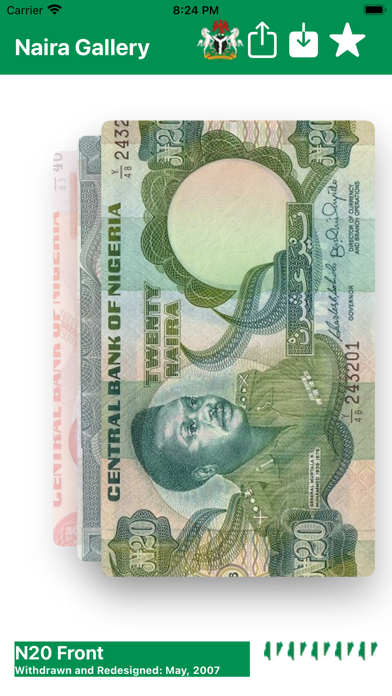
On 11th February 1977, a new banknote with the value of twenty naira (₦20) was issued. It was the highest denomination introduced at the time as a result of the growth of the economy; the preference for cash transactions and the need for convenience.
The banknote was the first in Nigeria to bear the portrait of a prominent Nigerian citizen, the late Head of State, General Murtala Ramat Muhammed (1938-1976) who was the torch bearer of the Nigerian Revolution in July, 1975. The note was issued on the 1st anniversary of his assassination as a fitting tribute to a most illustrious son of Nigeria. He was declared a national hero on 1st October 1978.
On 2nd July, 1979, new currency banknotes of three denominations, name