ISS Transit Finder & Tracker

ISS Transit Finder & Tracker Summary
ISS Transit Finder & Tracker is a free iOS app in Books And Reference by Lucia Gonzalez. Released in Aug 2026 (2 months ago). Store last updated Sep 27, 2026
ISS Transit Finder & Tracker SDKs Summary
App not yet scanned for SDKs.
0★
Ratings: 0
Screenshots


App Description
ISS Transit Finder tells you when and where the International Space Station and other satellites cross in front of the Sun or the Moon as seen from your exact spot.
A transit lasts under a second, so timing and position are everything. The app finds these rare alignments and shows you precisely where to stand to see or photograph one.
MUCH MORE THAN TRANSITS
- Live Station: the ISS on a world map, with its orbit, the day/night line across the Earth and the crew in space right now.
- ISS guide: key facts, modules, history and how to spot it with the naked eye.
- Launches: the worldwide launch schedule (SpaceX, NASA, ESA, Rocket Lab and more) with live countdowns and reminders.
- News: space headlines from specialized outlets.
- Explore: NASA's Astronomy Picture of the Day, agencies, documents, observer tools and a glossary.
HOW IT WORKS
- Set your location by GPS, by tapping the map, or by typing coordinates.
- Choose a date range of up to 30 days and how far you are willing to travel.
- Pick the bodies (Sun, Moon) and satellites (ISS, Hubble, Tiangong).
- Tap Calculate and get every transit visible within your travel radius.
FOR EACH TRANSIT YOU GET
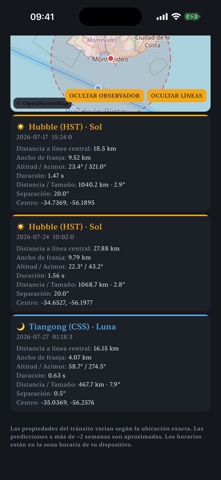
- Local date and time, in your device's time zone.
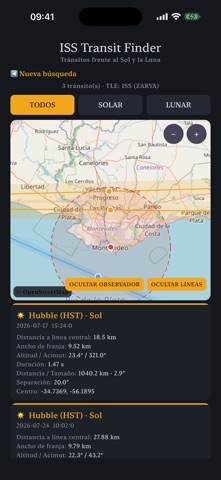
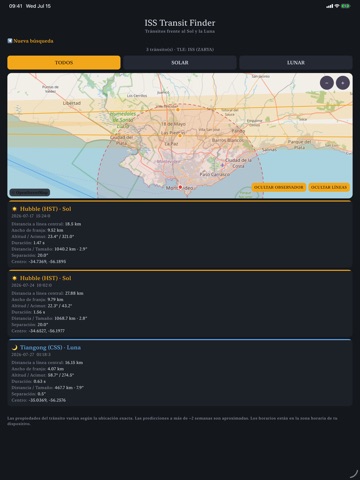
- Distance to the central line and the width of the visibility band.
- Altitude and azimuth, so you know exactly where to look.
- Duration, satellite distance, angular size and separation.
- The exact center coordinates, plotted on an interactive map.
WHO IT IS FOR
Astrophotographers chasing that once-in-a-season shot, amateur astronomers, and anyone curious about what is passing overhead.
Predictions beyond about two weeks are approximate and refine as the date nears, so always check again close to the event.