Studiolo: The Long Study

Studiolo: The Long Study Summary
Studiolo: The Long Study is a free, with in-app purchases iOS app in Education by David Hamm. Released in Sep 2026 (1 month ago). Store last updated Sep 1, 2026
Studiolo: The Long Study SDKs Summary
App not yet scanned for SDKs.
0★
Ratings:
Screenshots




App Description
A course of study with no commencement.
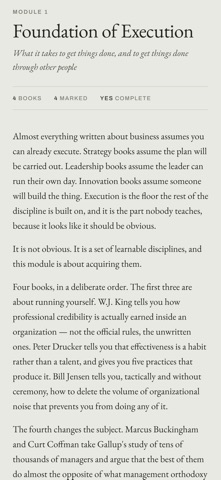
Fifteen shelves, seventy-six books, and one capstone for each shelf that a professor reads and grades against a fixed rubric. There is no schedule, no page target and no term. You mark a book when you finish it, and a shelf closes when its books are marked.
It began over the course of about a year as one reader's private reading program — an MBA in everything but the tuition. What started as a curriculum turned into a habit, and more shelves are added as subjects become interesting.
WHAT A STUDIOLO IS
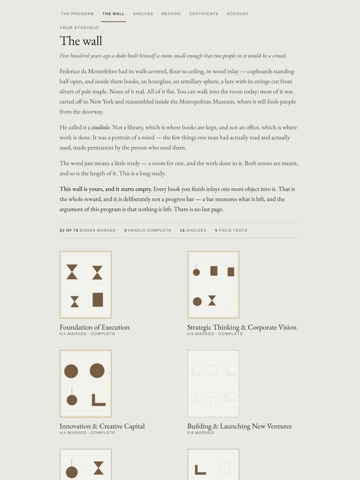
A small private study — one room, big enough for one person and a chair. The famous ones belonged to Federico da Montefeltro around 1476, and their walls were covered floor to ceiling in wood inlay: cupboards standing half open with books, an hourglass, an armillary sphere inside them. None of it real. All of it flat. A portrait of a mind, made permanent by the person who used it.
Your wall works the same way. Every book you finish inlays one more object into it. That is the whole reward. There is no progress bar, because a bar measures what is left, and the argument of this program is that nothing is left.
THE SHELVES
Execution. Strategy. Innovation. New ventures. Consulting. Leadership. Communication. Financial fluency. Analytical thinking. Design. Sales. Recruiting. Generative AI. Coaching. Mergers and acquisitions.
Each shelf holds three to eight books chosen because they disagree with each other. Every book arrives with an argument for why it is there, what it contributes, and one question you answer when you finish it — a question you could not answer from the jacket copy.
THE PROFESSOR
Write the capstone and it is read against that shelf's grading instrument: a document you never see, holding the concept inventory for every book on the shelf and the anchored standard for that module. Four dimensions are marked — rigor, clarity, integration, insight.
The evaluator never proposes an overall grade. The aggregate is arithmetic from a fixed weighting, computed outside the evaluation, so two people who write the same capstone receive the same result. A second reader then checks every letter against the instrument's own written anchors and may move one.
The feedback names something you did that a weaker writer would not have, states the central weakness in one sentence, and shows the connection that wa