Fun with Verbs & Sentences LT

Fun with Verbs & Sentences LT Summary
Fun with Verbs & Sentences LT is a mobile iOS app in Education by Hamaguchi Learning & Development, LLC. Released in Oct 2013 (12 years ago). It has 5.00 ratings with a 4.00★ (good) average. Based on AppGoblin estimates, it reaches roughly 3.00 monthly active users . Store metadata: updated Aug 15, 2018.
Store info: Last updated on App Store on Aug 15, 2018 .
4★
Ratings: 5.00
Screenshots

App Description
If you loved our First Phrases app, you’ll love this app too! Fun with Verbs & Sentences is the next step up for children who are learning to speak in sentences, understand past and present verb tensing, and formulate basic syntax structures.
Developed for language ages 2-5, with eye-popping color drawings and 45 delightful animations--a cutting-edge way to show and teach action words! For a demonstration of this app, please check out our YouTube video http://www.youtube.com/watch?v=oUcYWlJ27yw.
This app is for the iPhone, and designed for a single user. It provides three verbs for each sentence type selected including: catch, eat, fall, go, hide, jump, play, push, sing, and sneeze.
Want to show animations simply to elicit sentences and verb forms? Just select the "Watch & Say" activity--also a great pre/post assessment tool. Select the verbs from 10 choices or random, and choose the target syntax structures.
Here’s how to play the main activity, Build a Sentence:
1) Choose your subject: There are three character choices in this app: a boy, a girl, and a bear.
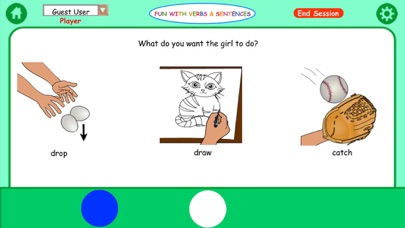
2) Then choose your verb: There are always 3 verb choices for Subject + Verb + Object: catch, eat or push.
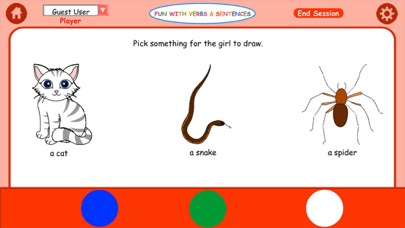
3) Choose your object or prepositional phrase: The last step is choosing something for the child to eat.
4) The narrator voices each part of the sentence slowly, as the circles flip back around, one at a time, to reveal the associated pictures: “The girl…is eating…a carrot.”
Unless de-selected, the narrator will then model the sentence at a quicker speaking pace, “The girl is eating a carrot.” The child is complimented for the sentence and then instructed, “After the video, it will be YOUR turn to say the sentence.”
5) The animation that shows the sentence that was created (i.e., “The girl is eating a carrot”) is now shown, typically with a sound effect. If the verb is present tense, (which is the default) it snaps back and loops continually, without sound.
6) The child is asked, “What is happening? Tell me the whole sentence.” “
If used in therapy, the data tracking features on the left can be used. (This can be de-selected within the settings if no desired)
*If past tense verb forms have been selected, the animation is shown only once and the narrator asks, “What happened?” If the user would like to target the verb only, this can be selecte