SkEye | Astronomy


SkEye | Astronomy Summary
SkEye | Astronomy is a with in-app purchases Android app in Books And Reference by Harshad RJ. Released in Dec 2010 (15 years ago). It has about 3.9M+ installs and 15.2K ratings with a 4.39★ (good) average. Based on AppGoblin estimates, it reaches roughly 1M monthly active users and generates around $100K+ monthly revenue (100% IAP / 0% ads). Store metadata: updated Nov 17, 2025.
Recent activity: 758.2K installs this week (1.5M over 4 weeks) showing exceptional growth , and -3 new ratings this week View trends →
Data tracking: SDKs and third-party integrations were last analyzed on May 12, 2025. The app's network data flows (API traffic to/from the app and its SDKs) were last crawled on Sep 30, 2025.
Store info: Last updated on Google Play on Nov 17, 2025 .
SkEye | Astronomy was last scanned for SDKs 2025-05-12. Below is the overview of third party companies detected in the app. The full list of raw SDKs, app permissions and unknown SDKs is available here.
 Google
4.39★
Ratings: 15.2K
Screenshots


App Description
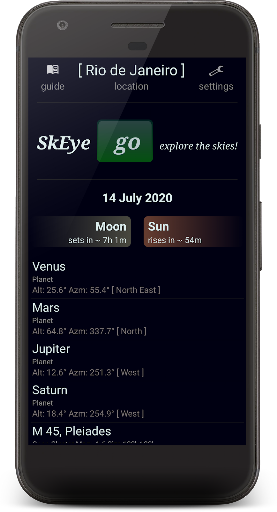
A map of stars, planets, meteor showers, galaxies and nebulae.
SkEye is a planetarium that can also be used as a PUSHTO guide for telescopes.
Get familiar with the sky by identifying stars, planets, and constellations. For the dedicated sky-gazers there are meteor showers, bright comets and deep sky objects from the Messier and NGC catalogs.
If you have a telescope, just strap the phone onto the OTA to get a PUSHTO guide!
‣ Features
• Time machine : Jump to any date in past or future
• Real time Alt-Azimuth and Equatorial coordinates
• Messier objects
• mini-NGC catalog (subset of ~180 bright objects)
• Solar system objects including all 8 planets and the 4 Galilean moons
• Meteor showers, including Perseids, Geminids, Leonids
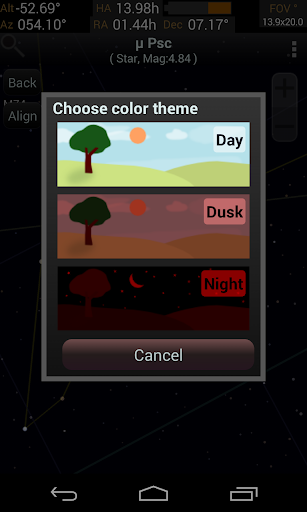
• Night Mode
• Search, with a guiding arrow
• Alt-Azimuth, Equatorial grid
• Aligned mode, for PUSHTO guidance
‣ Queries?
Send an email to hi.skeye@gmail.com.
‣ Tips:
• For better accuracy, calibrate the magnetic sensors by waving the phone in a figure-8 motion of your hands.
• For advanced use read: https://lavadip.com/skeye/docs.html
• If you would like to help with translations: https://crowdin.com/project/skeye
‣ App Permissions
• Location: to determine accurate position of celestial objects
• Bluetooth: to support remote sensors