THE CRITIQUE OF PURE REASON


THE CRITIQUE OF PURE REASON Summary
THE CRITIQUE OF PURE REASON is a ad-supported Android app in Books And Reference by Quantum Power App. Released in Jul 2022 (3 years ago). It has about 446+ installs Based on AppGoblin estimates, it reaches roughly 57 monthly active users and generates around $<10K monthly revenue (0% IAP / 100% ads). Store metadata: updated Jul 23, 2024.
Recent activity: 2.00 installs this week (76 over 4 weeks) showing exceptional growth View trends →
Store info: Last updated on Google Play on Jul 23, 2024 .
0★
Ratings: 0
Screenshots


App Description
Immanuel Kant, defined metaphysics in his book The Critique of Pure Reason.
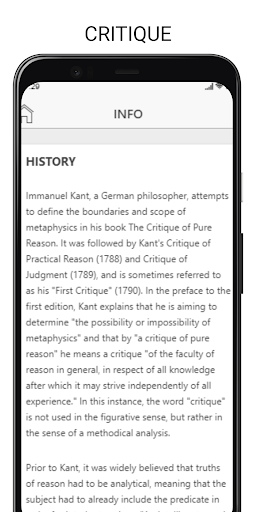
Immanuel Kant, a German philosopher, attempts to define the boundaries and scope of metaphysics in his book The Critique of Pure Reason. It was followed by Kant's Critique of Practical Reason (1788) and Critique of Judgment (1789), and is sometimes referred to as his "First Critique" (1790). In the preface to the first edition, Kant explains that he is aiming to determine "the possibility or impossibility of metaphysics" and that by "a critique of pure reason" he means a critique "of the faculty of reason in general, in respect of all knowledge after which it may strive independently of all experience." In this instance, the word "critique" is not used in the figurative sense, but rather in the sense of a methodical analysis.
Prior to Kant, it was widely believed that truths of reason had to be analytical, meaning that the subject had to already include the predicate in order for it to be true (e.g., "An intelligent man is intelligent" or "An intelligent man is a man"). Because it is determined through evaluating the subject, the judgement is analytical in both situations. It was believed that all essential truths or truths based on reason are of this type and contain a predicate that only refers to a portion of the subject being affirmed. If this were the case, every attempt to refute something that could be known a priori would include contradiction, such as "An intelligent man is not intelligent" or "An intelligent man is not a man."
At first, David Hume agreed with rationalism's broad stance on a priori knowledge. However, Hume found that several judgements that he had believed to be analytical, particularly those that dealt with cause and effect, were actually synthetic (i.e., no analysis of the subject will reveal the predicate). As a result, they are a posteriori and solely based on experience. Prior to Hume, rationalists had claimed that cause and effect could be derived from one another; Hume maintained that this was impossible and reasoned that nothing about cause and effect could be known a priori. Hume's scepticism severely troubled Kant, who had been brought up in a rationalist environment.