3D ECG Leads
3D ECG Leads Summary
3D ECG Leads is a mobile iOS app in Medical by XR Anatomy LTD. Released in Mar 2019 (7 years ago). It has 3.00 ratings with a 3.67★ (average) average. Based on AppGoblin estimates, it reaches roughly 4.00 monthly active users . Store metadata: updated Jul 26, 2020.
Store info: Last updated on App Store on Jul 26, 2020 .
3.67★
Ratings: 3.00
Screenshots
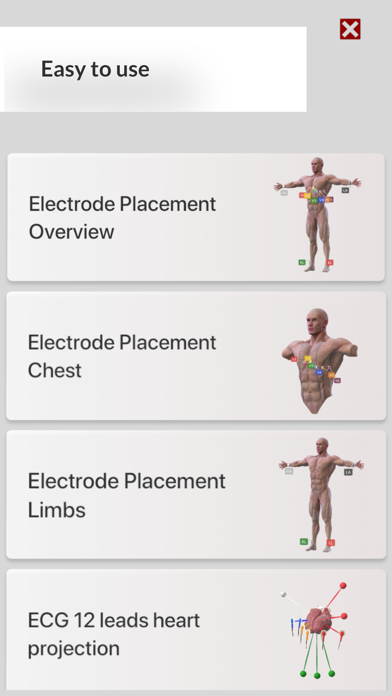
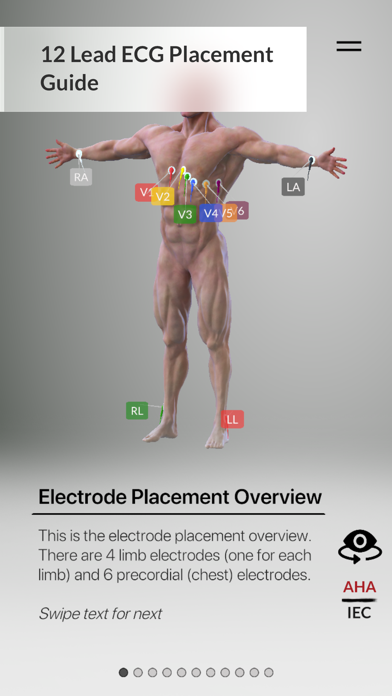
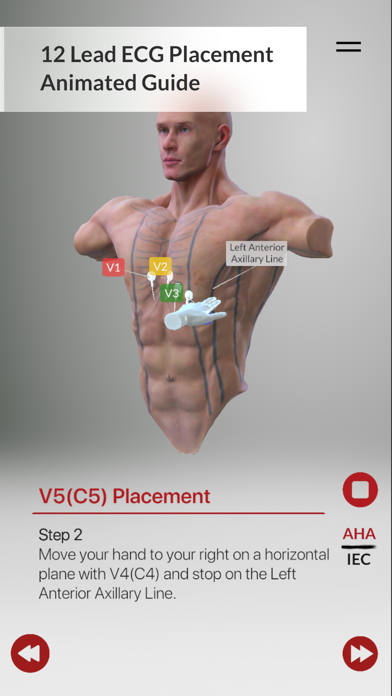


App Description
Why 3D ECG Leads ?
AN ECG LEAD PLACEMENT GUIDE
Misplacement of the ECG Leads may lead to wrong diagnoses and further unnecessary investigations or treatments (Jowett et al., 2005; Toosi and Sochanski, 2008; Harrigan, Chan and Brady, 2012; Ilg and Lehmann, 2012; Lynch, 2014). In their study (Medani et al., 2018) showed that in only 34% of cases, the ECG Chest Leads were placed correctly.
All medical personnel who are operating a 12 Lead ECG machine should have the appropriate training for ECG lead placement (Kligfield et al., 2007; Crawford and Doherty, 2010). The purpose of 3D ECG Leads is not aimed at replacing high-quality training but instead, to act as an aid and to show you in a simple 3D interactive way the Standard Lead Placement Technique.
AN ECG LEADS VISUALISATION TOOL
In a standard 12 Lead ECG Tracing, not all of the ECG Leads are organized in anatomical order. One recent study (Lindow et al., 2019) highlights the fact that displaying all the 12 ECG Leads in an anatomical sequence has a positive impact in diagnosing Acute Myocardial Infarction. 3D ECG Leads serves as a 3D interactive tool for the anatomical visualization of the ECG Leads.
WHY ONLY 10 LEADS. HOW AN ECG LEAD IS GENERATED.
With 3D ECG Leads you can visualize how the ECG Machine reads the heart's electrical activity, and how 3 Electrodes are generating 6 Leads.
References
Crawford, J. and Doherty, L. (2010) “Ten steps to recording a standard 12-lead ECG,” Practice Nursing, 21(12). doi: 10.12968/pnur.2010.21.12.622.
Harrigan, R. A., Chan, T. C. and Brady, W. J. (2012) “Electrocardiographic electrode misplacement, misconnection, and artifact,” Journal of Emergency Medicine. Elsevier Ltd, 43(6). doi: 10.1016/j.jemermed.2012.02.024.
Ilg, K. J. and Lehmann, M. H. (2012) “Importance of recognizing pseudo-septal infarction due to electrocardiographic lead misplacement,” American Journal of Medicine. Elsevier Inc., 125(1). doi: 10.1016/j.amjmed.2011.04.023.
Jowett, N. I. et al. (2005) “Modified electrode placement must be recorded when performing 12-lead electrocardiograms,” Postgraduate Medical Journal, 81(952). doi: 10.1136/pgmj.2004.021204.
Kligfield, P. et al. (2007) “Recommendations for the Standardization and Interpretation of the Electrocardiogram: Part I: The Electrocardiogram and Its Technology A Scientific Statement From the American Heart As