Noise Gate & Downward Expander

Noise Gate & Downward Expander Summary
Noise Gate & Downward Expander is a mobile iOS app in Music And Audio by Blue Mangoo Consulting Company Limited. Released in Nov 2019 (6 years ago). It has 7.00 ratings with a 4.86★ (excellent) average. Based on AppGoblin estimates, it reaches roughly 15 monthly active users . Store metadata: updated Jul 6, 2022.
Store info: Last updated on App Store on Jul 6, 2022 .
4.86★
Ratings: 7.00
Screenshots
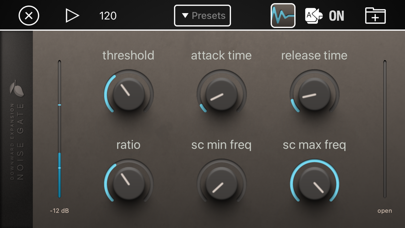

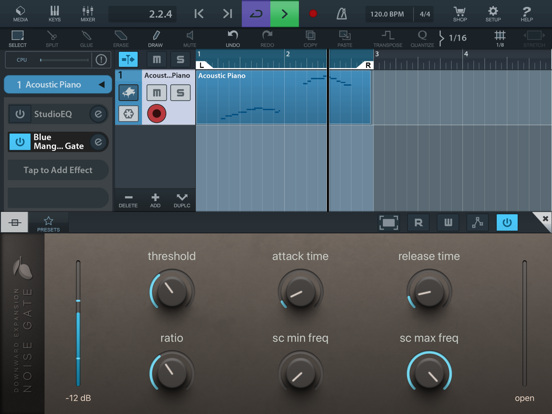

App Description
WHAT DOES THIS PLUGIN DO THAT OTHER NOISE GATES DON'T?
Most of the iOS recording apps already come with a built-in noise gate effect. So why do you buy another noise gate? There are 2 main reasons: clearer sound and more natural gate-closing sound.
1 - DOWNWARD EXPANSION SOUNDS MORE NATURAL THAN OPEN & SHUT GATING
The simplest noise gate plugins simply set the volume to zero when the input level drops below a threshold. The abrupt change in volume from that process sounds unnatural and makes it obvious that you are using a noise gate plugin on the signal. Instead of using a gate that fluctuates between two states (open, closed), this plugin uses downward expansion to gently and smoothly reduce the gain as the input drops below the threshold setting.
An example to illustrate this:
With the downward expansion ratio set at 2:1 and the threshold at -10 dB, when the signal drops below the -10 dB threshold level, the plugin doubles its distance from the threshold. So a signal that comes in 2 dB below the threshold goes out 4 dB below; 10 dB below the threshold comes out 20 dB below, and so on. The big advantage to this method is that when the signal is just slightly below the threshold, say 1/2 dB for example, it won't be reduced all the way down to zero volume, so you don't hear an abrupt change as the signal drops below the threshold. Instead it just seems that the quiet sounds are even quieter, and they decay faster than they normally would. This allows you do eliminate a lot of background noise without the listener knowing that you are using a noise gate.
2 - SMOOTHER FILTERING IN THE ENVELOPE FOLLOWER MEANS LESS DISTORTION
The key challenge that all noise gate designs struggle to overcome is how to make sure the gate doesn't flutter open and closed several times at the end of a sound. This is a serious challenge because the input signal is a wave, meaning that it is constantly moving up and down and it crosses above and below the threshold with every up and down motion. How to keep the gate from opening and closing in time with the oscillation of the sound waves? There are many ways to do it, but the basic idea is to slow the gate down somehow, so it can't open and shut too quickly. Of course, slowing the gate down or delaying its closing is not desirable because we need it to close as quickly as possible when the input signal ends and open immediatel